
Air Duct Sanitizing Service in Tennessee: What It Actually Takes to Do It Right
Professional air duct sanitizing service in Tennessee runs $275–$550 for a typical residential system when performed as a standalone treatment, or $150–$300 when bundled with a full mechanical cleaning. Call (844) 621-7071 for a free estimate — Ronald Sanchez, the owner, personally inspects every system before recommending sanitizing, because not every home actually needs it. At Nova Air Duct Cleaning Tennessee, we’ve built our reputation on telling homeowners when their ducts are clean enough to leave alone.
Tennessee’s climate works against your ductwork in ways that aren’t obvious until you’re staring at the inside of a supply line. Summers here push relative humidity to 70–80% outdoors, and attic duct runs often sit at 55–65% humidity even with the AC running. That moisture, combined with the temperature differential between conditioned air and hot attic spaces, creates condensation points where biological material can colonize. We’ve pulled return vent covers in homes from Germantown to Collierville and found the same thing: a felt-thick layer of biofilm on the duct wall that no amount of fogging reaches unless the surface is mechanically cleaned first. That’s where most sanitizing services fail — they skip the hard work and sell you a scented mist.
Why Sequence Matters: Clean First, Sanitize Second
Here’s the industry secret that budget operators don’t advertise: fogging a disinfectant into a dirty duct encapsulates biological material rather than eliminating it. The sanitizer lands on dust, pet dander, and existing mold fragments, forming a thin coating that may smell clinical but leaves the underlying contamination intact. We’ve seen this in homes across Tennessee where a previous “sanitizing” left visible debris still clinging to the duct walls — the homeowner paid for peace of mind and got a chemical cover-up.
Legitimate air duct sanitizing service requires three sequential steps:
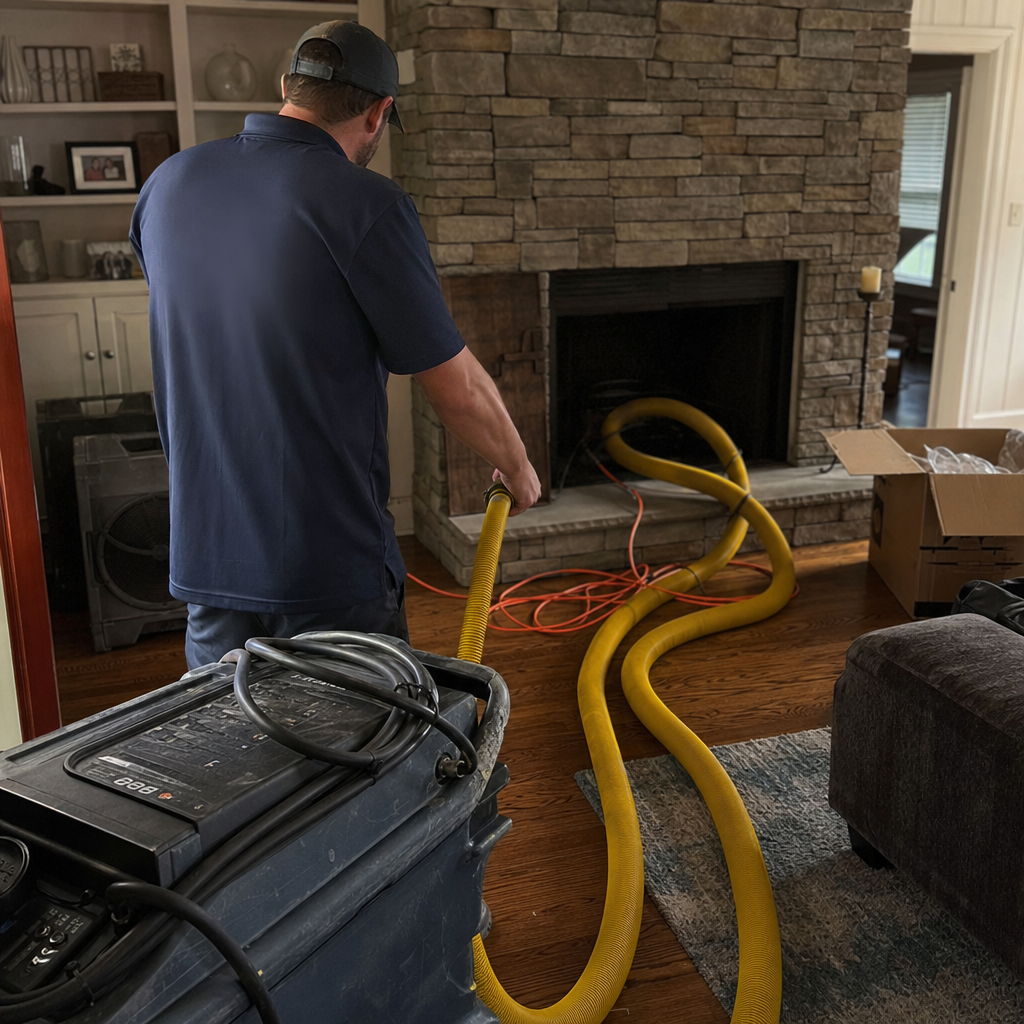
- Mechanical agitation and extraction — We use Rotobrush rotary-brush systems and Nikro negative-air machines to physically dislodge buildup and pull it out of the system. The duct surface must be bare metal or bare liner before sanitizer application.
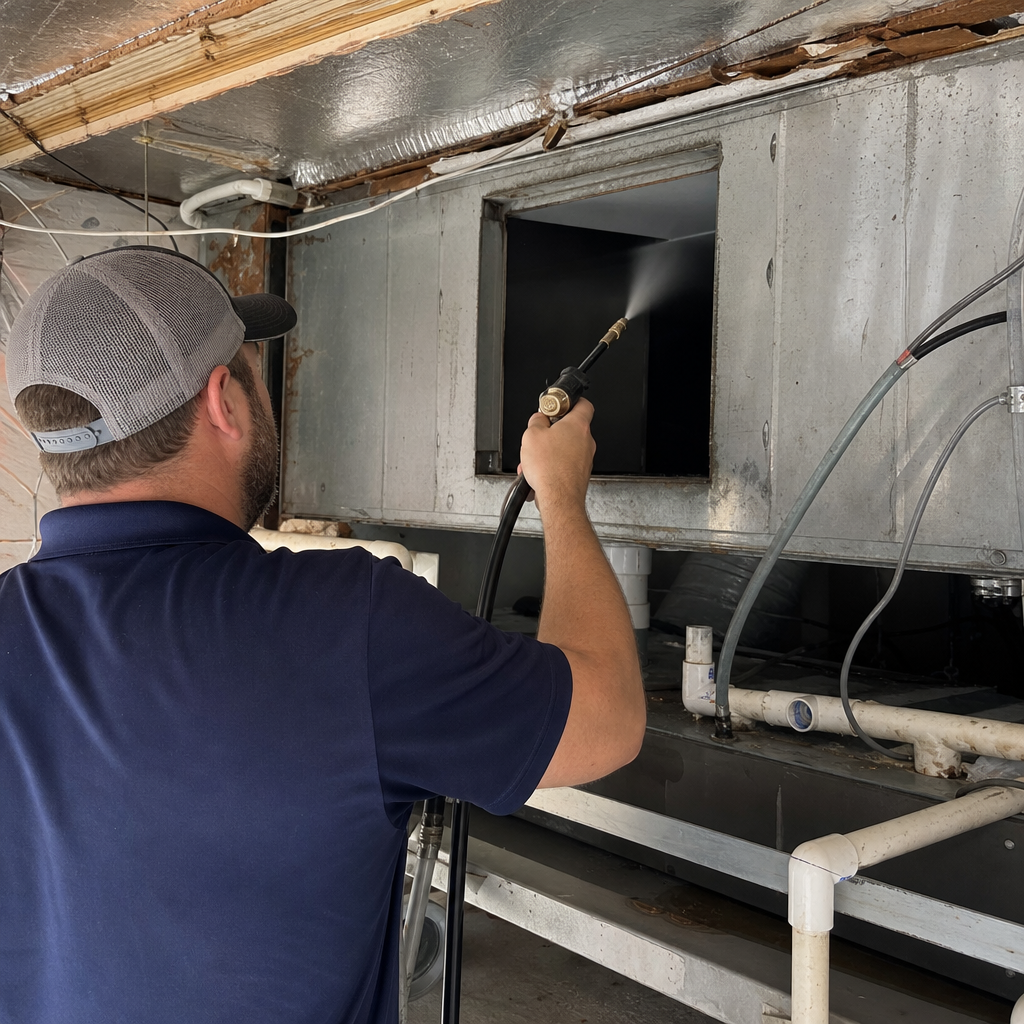
- Targeted application of EPA-registered product — We apply with Abatement Technologies equipment, the same negative-air and precision-application systems used in commercial remediation environments, not a pump sprayer from the hardware store.
- Dwell time verification and airflow restoration — The product must sit on the surface for its labeled contact time, typically 10–15 minutes for most EPA-registered solutions, before the system is returned to service.
Skip any step and you’re not sanitizing — you’re perfuming. Ronald Sanchez learned this the hard way early in his career, watching a subcontractor fog a system that still had visible mold staining. “I’ll tell you what’s in there, what it means, and exactly what it takes to fix it — nothing more.” That experience shaped how Nova operates today: inspection first, honest assessment, no automatic add-ons.
What Tennessee’s Humidity Means for Your Ducts
The specific trigger for sanitizing in Tennessee homes isn’t arbitrary — it’s environmental. Our state’s summer moisture profile creates near-ideal conditions for mold spore germination on duct lining, particularly in homes with any of these risk factors:
- Prior water intrusion, even resolved years ago — residual spores persist in porous duct liner
- HVAC condensate drain issues or pan overflows that wet nearby ductwork
- Crawlspace or attic duct runs with inadequate insulation, creating chronic condensation
- Homes with multiple pets where dander accumulation provides organic substrate for microbial growth
- Occupants with asthma, allergies, or compromised immune systems who react to low-level bioaerosol exposure
In neighborhoods like the older subdivisions near Bartlett or the ranch-style homes common in Cordova, we’ve found that original fiberglass duct liner from the 1980s and 1990s acts like a sponge for humidity and organic material. These systems don’t just need cleaning — they need the full assessment that determines whether sanitizing is warranted or whether the liner itself has degraded past saving. That’s a conversation we have on-site, not a checkbox on a service menu.
What You’re Actually Paying For: Products, Methods, and Honest Assessment
Not all sanitizing is equal, and the differences matter for both efficacy and safety. Here’s what separates legitimate service from a upsell:
| Component | Budget Approach | Professional Standard (Nova) |
|---|---|---|
| Pre-cleaning | Light vacuum or skipped entirely | Rotobrush mechanical agitation + Nikro negative-air extraction |
| Application equipment | Pump sprayer or consumer fogger | Abatement Technologies precision-application system |
| Product registration | Often unverified “green” claims | EPA-registered disinfectants with verified kill claims for HVAC use |
| Post-application verification | None — “trust us” | Visual inspection of treated surfaces, system restart with air quality check |
| Standalone sanitizing | $99–$199 (red flag pricing) | $275–$550 |
| With full duct cleaning | $50–$100 add-on | $150–$300 add-on |
The product itself matters too. “Green” and “non-toxic” are marketing terms, not regulatory categories. We use EPA-registered solutions with specific kill claims for the organisms most relevant to HVAC systems — primarily Aspergillus, Penicillium, and Stachybotrys species common in Tennessee’s humid environments. For households with chemical sensitivities, we can source botanical-based alternatives, but we explain the trade-off: reduced contact-time efficacy that may require repeat application. No surprises, no vague reassurances.
UV light installations come up frequently in these conversations. UV-C lamps installed downstream of the coil can suppress microbial growth on wet surfaces, but they don’t sanitize existing duct contamination — the exposure time and intensity at duct-wall distance aren’t sufficient. We install Honeywell and Aprilaire UV systems where appropriate, but we don’t present them as a substitute for physical cleaning and targeted sanitizing when the ducts are already compromised.
Who Actually Needs Sanitizing — and Who Doesn’t
This is where our approach diverges sharply from competitors who bundle sanitizing into every quote. After eight years and hundreds of Tennessee homes, Ronald Sanchez has a clear decision framework:
Genuine candidates for sanitizing: Homes with documented water damage history, visible mold staining inside ducts, persistent musty odors that survive cleaning, or occupants with severe allergies or immunocompromise. We’ve also recommended it for rental properties between tenants where pet dander accumulation was extreme, and for homes where HVAC systems sat idle for extended periods — common in foreclosure or estate situations.
Probably unnecessary: Systems that test clean after mechanical extraction, with no moisture history and no symptomatic occupants. In these cases, we’ll document what we found, explain why sanitizing won’t add value, and leave it at that. Our Air Quality & Sanitizing in Tennessee page covers the full scope of when these services make sense.
This policy costs us revenue in the short term. We’ve walked away from jobs where the homeowner expected sanitizing and we determined it wasn’t warranted. But it’s why we’ve maintained a 4.7-star average across 90 verified reviews — customers remember honesty when they’ve been burned by upsells elsewhere.
What to Expect During a Nova Sanitizing Appointment
Ronald Sanchez arrives with the equipment, not a crew of trainees. For a typical Tennessee home — say, a 2,000-square-foot ranch with a single HVAC system — the process runs like this:
- Pre-inspection with photo documentation — We show you what we’re seeing before touching anything. If the ducts don’t justify sanitizing, we say so.
- Full mechanical cleaning if not already performed — Rotobrush through each branch line, Nikro negative-air on the trunk. No shortcuts.
- Sanitizer application with Abatement Technologies equipment — Targeted fogging at proper particle size for duct-wall contact, not saturation that pools in low spots.
- Dwell period with system sealed — Typically 10–15 minutes depending on product specification.
- Post-treatment airflow and visual verification — We restart the system and confirm treated surfaces show even coverage without residue buildup.
Total time on site: 3–5 hours for a complete cleaning-plus-sanitizing job. Standalone sanitizing (rare — only when ducts were recently cleaned by another provider and we verify their work) runs 1.5–2 hours.
FAQs
Standalone air duct sanitizing service in Tennessee typically costs $275–$550 for a residential system, while bundling it with full mechanical cleaning reduces the add-on to $150–$300. The final price depends on system size, accessibility of duct runs, and whether we find conditions that require extended treatment time. Call (844) 621-7071 for an exact quote — estimates are free, and we’ll tell you honestly if your system doesn’t need it.
EPA-registered sanitizers can kill mold on accessible duct surfaces, but they cannot eliminate established growth inside porous duct liner or behind insulation — those situations typically require physical removal and replacement. In Tennessee’s humid climate, we frequently find that older fiberglass-lined ducts have absorbed moisture and organic material too deeply for surface treatment to be sufficient. We’ll show you what we’re dealing with during inspection and recommend the appropriate scope, whether that’s sanitizing, liner replacement, or in severe cases, partial duct reconstruction with our duct repair & sealing capabilities.
Professional-grade EPA-registered sanitizers are safe when applied according to label directions with proper dwell time and ventilation, which is why we don’t rush the process or skip the post-treatment verification step. We use products specifically formulated for HVAC application, not general-purpose disinfectants, and we can discuss botanical-based alternatives for households with specific chemical sensitivities. Occupants should plan to be out of the home for 2–4 hours during and immediately after treatment as a standard precaution.
Ask to see the equipment: legitimate duct cleaning requires rotary brushes or whip systems and negative-air extraction units, not just a fogger. Request before-and-after photos from inside your specific ducts — we provide these as standard practice. Be wary of quotes under $200 for “sanitizing” or any service that doesn’t include visible mechanical agitation. At Nova, Ronald Sanchez performs the inspection himself and explains what he finds before recommending any additional service, a level of transparency that franchise crews with rotating subcontractors rarely match.
Ready to Know What’s Actually in Your Ducts?
Don’t guess whether your Tennessee home needs sanitizing — and don’t trust a company that guesses for you. Call (844) 621-7071 to schedule a free inspection with Ronald Sanchez, owner and lead technician at Nova Air Duct Cleaning Tennessee. We’ll show you what’s inside your system, explain what it means for your air quality, and recommend exactly what it takes to fix it — nothing more. No franchise crews, no automatic upsells, just eight years of specialized experience and the professional equipment to back it up.
Written by Ronald Sanchez, Owner & Lead Technician at Nova Air Duct Cleaning Tennessee, serving Tennessee, TN.