
Whole House Air Duct Cleaning Cost in Tennessee: What the Quote Actually Covers
Whole house air duct cleaning in Tennessee typically runs $400–$900 for a thorough job on a standard residential system, with most Tennessee homeowners landing in the $550–$750 range for complete cleaning of supply and return ductwork, registers, grilles, and the air handler cabinet. Call (844) 621-7071 for a free, no-surprises estimate — Ronald Sanchez, our owner and lead technician, inspects your system before quoting so the price you hear is the price you pay.

Here’s something we’ve learned after eight years crawling through attics across Tennessee: two neighbors with identical 2,000 square foot houses can get the same “whole house” quote and end up with completely different scopes of work. The difference hides in about fourteen words buried in the fine print — “includes up to X vents” or “main trunk lines additional.” One homeowner gets a genuine system-wide cleaning. The other gets a glorified register wipe-down. We’ll show you exactly how to tell which quote you’re actually getting.
What “Whole House” Must Actually Mean
A legitimate whole house duct cleaning in Tennessee covers five distinct zones. Skip any of them, and you’re paying for a partial job while breathing air through the sections nobody touched.
Here’s what belongs in the scope:
- Supply registers and return grilles — the visible endpoints where air enters your rooms
- Supply and return plenums — the large sheet-metal boxes connecting your air handler to the trunk lines
- Air handler cabinet interior — the blower compartment, evaporator coil area, and filter rack
- Main trunk lines — the primary distribution ducts running through your attic, crawl space, or basement
- Branch ducts to each vent — the smaller lines feeding individual rooms
The $199 specials flooding Tennessee mailboxes? We’ve seen their work. They typically hit the first item — registers — and call it done. Some will run a vacuum hose a few feet into the trunk line. Almost none open the air handler cabinet. That cabinet is where your blower motor sits, where dust cakes onto the evaporator coil, where microbial growth often starts. Leaving it untouched means your “clean” ducts immediately get recontaminated the next time your HVAC cycles on.
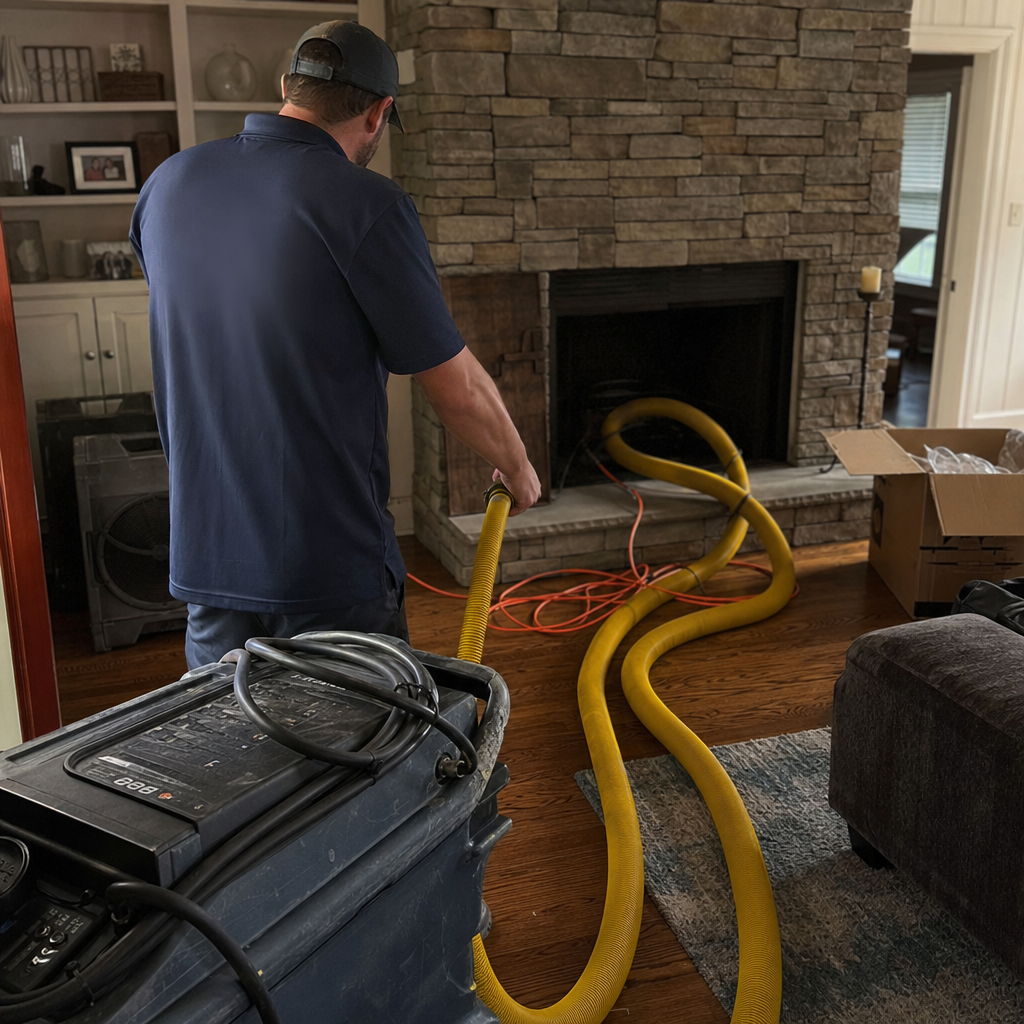
We use Rotobrush rotary-brush systems and Nikro negative-air machines — the same equipment you’ll find in commercial and industrial cleaning operations — because residential ductwork in Tennessee deserves the same thoroughness as a hospital or school system. These aren’t repurposed shop vacs with fancy branding. They’re purpose-built for agitating and extracting debris from metal, fiberglass, and flex duct without damaging the material.
Why Tennessee’s Housing Stock Makes Quotes Vary
Tennessee’s neighborhoods tell a story of layered construction. Drive through East Memphis or the older sections of Cordova and you’ll find 1960s ranch homes built on slab foundations with original galvanized steel trunk lines. Then you hit a 1980s addition with flex duct run through an attic that hits 140 degrees in July. Cross into Collierville or Germantown and the 1990s two-story colonials arrive with dual-zone systems, multiple air handlers, and a maze of ductwork that would’ve seemed extravagant two decades earlier.
This matters for your quote because each material cleans differently. Metal trunk lines handle aggressive rotary brushing well. Flex duct — the ribbed, insulated tubing common in additions and retrofits — requires gentler handling. Some flex duct sections in Tennessee attics have sagged, collapsed, or been crushed by storage boxes, making them partially or fully inaccessible without disassembly. That’s not a corner to cut; it’s a condition to document and discuss before work starts.
Ronald Sanchez grew up near Germantown watching his uncle run an HVAC service route through these exact neighborhoods. He learned early that a house in Hickory Hill with original 1970s metal ductwork is a fundamentally different job than a 2005 build in Arlington with all-flex attic runs. That local pattern recognition is why we don’t quote blind over the phone for whole-house work. We’ll ask about your home’s era, your system’s layout, and whether you’ve had additions or HVAC modifications. Then we schedule a brief visual inspection — usually ten minutes — to confirm what we’re working with before any number gets attached.
The Square Footage Myth: Why It’s the Wrong Number
Here’s where most Tennessee homeowners get tripped up. Square footage is easy to state — it’s on your Zillow listing, your tax records, your memory. But it’s a rough proxy at best for duct cleaning scope. The accurate pricing unit is your system count and vent configuration.
Consider two 2,000 square foot homes we serviced last month in Tennessee:
| Home Configuration | System Details | Actual Cleaning Scope | Price Range |
|---|---|---|---|
| Single-story ranch, 1965 build | 1 system, 12 supply registers, metal trunk lines | 12 supplies, 3 returns, 1 plenum, 1 air handler, main trunk | $450–$650 |
| Two-story colonial, 1994 build | 2 systems, 22 total registers, flex + metal mix | 22 supplies, 4 returns, 2 plenums, 2 air handlers, dual trunks | $750–$950 |
Same square footage. Different job by nearly double the labor and equipment time. Any quote that doesn’t ask which configuration you have isn’t a real quote — it’s a bait number designed to get a foot in the door.
Our process starts with a quick register count and system location check. We ask whether your thermostat controls one zone or multiple. We confirm whether your air handler lives in the attic, a closet, or the garage. These details change the access difficulty, the hose run length, and the time required. Only then do we talk numbers.
What Tennessee’s Climate Does to Your Ductwork
Tennessee’s humidity isn’t news to anyone who’s sweated through a July afternoon. But its effect on ductwork is less understood. Our region’s combination of hot, humid summers and occasional winter freeze cycles creates conditions that accelerate duct contamination in specific ways.
High humidity means condensation forms on cooler duct surfaces, particularly in attic runs where unconditioned air meets conditioned supply lines. That moisture layer catches and holds dust particles that would otherwise pass through. Over seasons, this creates a sticky, layered buildup — not loose dust you could blow out with compressed air, but adhered grime requiring mechanical agitation.
We’ve pulled sections of flex duct in Tennessee attics where the interior lining had developed a thin biofilm layer from years of this cycle. It’s not mold in the legal sense — no visible colonies — but it’s absolutely a reservoir for allergens and odors. Our process includes inspection for these conditions and, when appropriate, sanitizing with Guardsman products applied after mechanical cleaning. We don’t sell sanitizing as a mandatory upsell. We recommend it when our inspection finds conditions that warrant it, and we discuss it before we start the cleaning, not after we’ve packed up half our equipment.
Reading a Quote: Red Flags and Green Lights
After eight years and ninety verified reviews, we’ve seen enough competitor quotes to recognize the patterns that separate legitimate operators from bait-and-switch artists. Here’s what to look for when you’re comparing whole house air duct cleaning costs in Tennessee.
Red flags — quotes to question:
- “Includes up to 10 vents” in a home you know has 16 — every additional vent triggers a per-unit fee
- No mention of the air handler cabinet — this is where recontamination happens
- “Free sanitizing included” that turns out to be a post-arrival mandatory charge
- Flat rate with no pre-service inspection or system count verification
- Equipment described as “high-powered vacuum” with no brand or specification
Green lights — quotes you can trust:
- Specific register count and system count built into the price
- Explicit inclusion of plenums, trunk lines, and air handler
- Pre-service visual inspection, even brief, before finalizing cost
- Named equipment — rotary brush systems, negative-air machines, HEPA filtration
- Clear policy on sanitizing: when it’s recommended, how it’s priced, when it’s discussed
Our policy is straightforward: the quote you receive after our inspection is the complete price. We don’t arrive with surprise per-vent fees. We don’t discover “mandatory” add-ons once we’re in your home. We don’t apply sanitizing treatments without prior discussion and your explicit go-ahead. Ronald built this structure after too many calls from Tennessee homeowners who’d been burned by operators who quoted $199 and left with $600 — and still hadn’t touched the air handler.
I’ll tell you what’s in there, what it means, and exactly what it takes to fix it — nothing more. That’s how we’ve maintained a 4.7-star average across ninety reviews. No drama, no upsell theater, just accurate scope and thorough execution.
What Professional-Grade Equipment Actually Delivers
The equipment gap between legitimate duct cleaning and budget operations is wider than most homeowners realize. We’ve encountered competitors in Tennessee using modified wet/dry vacuums with brush attachments — equipment that might dislodge surface dust but lacks the suction power to extract it from the system before it resettles.
Our Rotobrush systems use rotating cable-driven brushes sized to duct diameter, paired with simultaneous vacuum extraction through a separate hose. Debris gets agitated and removed in the same pass, not pushed deeper into the system. For larger trunk lines and commercial-scale jobs, our Nikro negative-air machines create controlled pressure differentials that pull dislodged material through HEPA filtration before it enters your home’s air.
We also deploy Abatement Technologies portable air scrubbers during cleaning — these run continuously in the work area to capture any particulate that escapes the contained duct system. It’s the same protocol used in hospital renovation projects and mold remediation. Your home’s air quality shouldn’t degrade during the process of improving it.
This equipment investment isn’t cosmetic. It directly affects whether your ducts are actually cleaner or just differently distributed after service. We’ve been called to re-clean systems that “professionals” serviced six months prior — the previous crew had loosened debris without extracting it, creating temporary improvement followed by rapid recontamination as settled dust re-entrained into airflow.
The Full Scope: Beyond Cleaning to Complete Air Quality
Here’s where Nova Air Duct Cleaning Tennessee diverges from operators who clean and leave. Our Air Duct Cleaning in Tennessee service is the entry point to a broader indoor air quality solution. After eight years specializing in this work, we’ve learned that cleaning alone sometimes addresses symptoms while underlying problems persist.
Duct leaks in Tennessee’s pressure-variable systems pull attic air, crawl space air, and garage air into your supply stream — air that’s often hotter, more humid, and more contaminated than what your filter sees. We offer Air Duct Cleaning with integrated leak detection and sealing, using methods that close these bypass paths without tearing into walls.
Similarly, cleaning a contaminated system without addressing the source — a failing filter, a bypassed return, an oversized unit that short-cycles without proper dehumidification — means you’ll be calling for service again sooner than you should. Our inspection includes evaluation of these contributing factors, with straightforward recommendations on whether additional services will actually save you money long-term.
We carry Honeywell and Aprilaire filtration products for homeowners ready to upgrade beyond standard disposable filters. These aren’t impulse add-ons; they’re solutions we discuss when your system’s design and your family’s sensitivities indicate they’ll deliver measurable benefit.
FAQs
Whole house air duct cleaning in Tennessee typically costs $400–$900, with most homes falling between $550–$750 for complete service including all registers, trunk lines, plenums, and the air handler cabinet. The exact price depends on your system count, total vent number, and duct accessibility — not just square footage. Call (844) 621-7071 for a free inspection and exact quote.
Repair and sealing is almost always cheaper than full duct replacement, and it’s often the right first step for Tennessee homes with isolated leaks, disconnected sections, or deteriorated flex duct in accessible areas. Full replacement runs $2,000–$5,000+ versus $300–$800 for professional sealing and targeted repairs. We inspect and quote both paths honestly — replacement only when repair won’t solve the problem. Call (844) 621-7071 to schedule an evaluation.
We typically schedule whole house cleanings within 2–3 business days, with same-day service sometimes available for urgent situations like post-renovation dust or allergy flare-ups requiring immediate attention. Emergency calls go directly to Ronald Sanchez, owner and lead technician, who’ll tell you honestly whether same-day is feasible or if a next-day slot gets you the same thoroughness without rushed preparation. Call (844) 621-7071 to check current availability.
Low quotes usually reflect limited scope — cleaning only visible registers, skipping trunk lines and air handlers, or charging per-vent fees that multiply the final bill. A legitimate whole house cleaning in Tennessee requires 3–5 hours of skilled labor with professional equipment like Rotobrush and Nikro systems, not a 45-minute vacuum pass. We quote complete scope upfront so you’re not comparing our full service to someone else’s partial job. Call (844) 621-7071 for transparent pricing.
Ready for an Honest Quote on Your Tennessee Home?
Don’t let fourteen words of fine print turn your whole house cleaning into a whole lot of disappointment. Ronald Sanchez, owner and lead technician at Nova Air Duct Cleaning Tennessee, personally inspects every system before quoting — no bait numbers, no surprise fees, no equipment that belongs in a garage rather than your ductwork. Call (844) 621-7071 today for your free estimate and see why ninety Tennessee homeowners have rated our work 4.7 stars. We’ll show you exactly what your system needs, what it costs, and how we get it done right the first time.
Written by Ronald Sanchez, Owner & Lead Technician at Nova Air Duct Cleaning Tennessee, serving Tennessee, TN.