
Signs You Need Dryer Vent Cleaning in Tennessee: The Early Warnings Most Homeowners Miss
Signs you need dryer vent cleaning include a laundry room that feels unusually humid after drying cycles, musty odors on supposedly dry clothes, and an exterior vent cap flapper that barely opens or stays stuck. In Tennessee’s climate, these symptoms often appear months before the classic warning of clothes needing two cycles to dry, because our ambient humidity turns lint buildup into dense, moisture-compacted clogs that standard DIY kits can’t fully clear. If you’re noticing any of these, call Nova Air Duct Cleaning Tennessee at (844) 621-7071 — we’ll confirm the restriction with measured airflow, not guesswork.

Why Tennessee’s Humidity Changes What “Clogged” Looks Like
Most online lists about dryer vent warning signs were written for dry climates. They’ll tell you to watch for longer dry times and a hot dryer exterior. Those are real signs, but they’re late-stage signs — the kind that show up after the problem has been building for months.
Here’s what eight years of crawling through attics and crawl spaces across Tennessee has taught us: our state’s humidity fundamentally changes how lint behaves inside a vent line. In Arizona or Colorado, lint stays fluffy and loose. It accumulates gradually, and a basic rod kit can often push it through. In Tennessee — from Memphis to Knoxville, from the river valleys to the Cumberland Plateau — that same lint absorbs ambient moisture and compacts into something closer to felt. It mats against vent walls, hardens in elbows, and creates a restriction that’s denser and more complete than a simple lint pile.
We’ve pulled clogs out of homes in Germantown and Collierville that looked solid enough to frame. The homeowner had run a rod through the year before and thought they were clear. They weren’t wrong — the vent passed a mechanical test. But the clog’s character had changed. Moisture had done its work.
This matters because it means Tennessee homeowners need to recognize earlier, subtler signs. By the time your clothes need two cycles, that moisture-compacted clog has already been forcing your dryer to work harder, cycling its heating element more frequently, and pushing humid exhaust air backward into your laundry room.
The Early Warning Signs: What to Notice Before Performance Drops
These are the signs we wish more Tennessee homeowners knew to watch for. They appear inside the house, in the laundry room itself, before the dryer’s internal sensors even register a problem.
Your laundry room feels humid after a drying cycle
A properly venting dryer pushes roughly a gallon of water out of your home with every load. When the vent is restricted, that moisture has to go somewhere. In Tennessee’s already-humid air, the difference is noticeable: you walk into the laundry room thirty minutes after starting a load and it feels like you’ve stepped into a bathroom after a shower. The walls may feel slightly damp. Paint or wallpaper near the dryer might show early discoloration.
We’ve had calls from homeowners in the Nashville suburbs who thought they had a plumbing leak. They didn’t. The dryer vent was backing moisture into the room, and the humidity was condensing on cooler surfaces. That’s not a dryer performance issue yet — it’s a vent restriction issue already in progress.
Musty smell on “dry” clothes
Your dryer tumbles clothes in heated air and evacuates that air through the vent. When evacuation is restricted, humid air lingers in the drum. Clothes come out feeling dry to the touch but carrying a faint mustiness — like towels left in the washer too long. You might rewash them, switch detergents, blame the washing machine. The real culprit is a vent that can’t clear moisture fast enough.
In Tennessee’s climate, this happens earlier and more persistently than in drier regions. The ambient humidity means the drum air starts wetter, and a partially blocked vent can’t overcome it.
The exterior vent cap flapper doesn’t open fully
This is the most overlooked diagnostic tool you have. Go outside during a drying cycle and watch your vent cap. The flapper should swing open briskly and stay open while the dryer runs. If it barely lifts, rattles in place, or only opens partway, you have a restriction. If it doesn’t open at all, you have a near-complete blockage.
We check this on every Dryer Vent Cleaning in Tennessee call. It’s the simplest, most reliable early indicator — and most homeowners never think to look.
Lint collecting around the exterior cap or on nearby siding
When back-pressure builds in a restricted vent, it forces lint out any gap it can find. You might notice lint accumulation on siding beneath the vent cap, or around the flapper itself, or even inside the laundry room where the duct connects to the dryer. This isn’t normal wear. It’s exhaust finding alternate paths because the primary path is blocked.
In Tennessee’s older housing stock — the ranch homes built in the 1960s and 70s, the split-levels with long vent runs through unconditioned crawl spaces — these signs show up predictably. The vent runs are longer, the elbows more numerous, and the humidity more relentless.
The Classic Signs — And What They Actually Mean Mechanically
Once the early warnings progress, you’ll see the symptoms every list mentions. But understanding why they happen helps you judge urgency and avoid the “just run it again” trap that burns out heating elements.
- Clothes take longer to dry or need two cycles. The dryer’s moisture sensors detect humidity in the drum and extend cycle time automatically. A restricted vent traps humid air, so the sensor keeps the cycle running. You’re not imagining it — the machine is responding to real data. But it’s working harder, heating longer, and wearing faster.
- The dryer exterior feels hot to the touch. Restricted airflow means heat can’t evacuate. The heating element cycles on more frequently and stays on longer. The cabinet temperature rises. This is the step before thermal fuse failure, which will shut your dryer down entirely until a repair technician replaces the fuse.
- Burning smell during operation. Lint is extremely flammable. When it accumulates near the heating element or in a hot exhaust path, you may smell scorching. This is not a “monitor and see” situation. Stop using the dryer and have the vent inspected.
- Visible lint inside the dryer door seal or lint trap housing. Back-pressure forces lint backward through gaps in the system. If you’re cleaning the lint trap religiously and still seeing accumulation around the door or in the trap housing, the vent isn’t pulling air through properly.
The mechanical chain is straightforward: lint restriction creates back-pressure, back-pressure traps heat and humidity, trapped heat stresses components, and stressed components fail. In Tennessee, the humidity in that chain makes every step happen faster and more severely.
What to Check at Your Exterior Vent Cap: A Visual Inspection
You don’t need tools for this. You need five minutes and access to the outside wall where your vent terminates.
Run the dryer on a heat cycle, then go outside and observe:
- Does the flapper open fully and stay open? Partial opening means partial restriction. No opening means complete blockage or a disconnected duct.
- Is lint visible around the flapper edges or on the cap housing? This indicates back-pressure forcing exhaust through gaps.
- Is the flapper stuck open when the dryer is off? Lint buildup or a damaged flapper spring can prevent proper closure. This lets pests, rain, and outside air into your vent line — compounding problems in humid climates.
- Is there discoloration on siding near the cap? Heat and humidity escaping around a poorly sealed vent can stain or warp exterior materials over time.
- Does the cap rattle or vibrate excessively? This can indicate turbulent airflow from a partial blockage creating pressure waves in the duct.
If you see any of these, the vent needs professional attention. A DIY rod kit might punch through a loose lint clog, but it won’t clear moisture-compacted buildup, and it won’t tell you whether the restriction is actually gone. That’s why we measure.
How We Confirm a Vent Is Actually Clear — Not Just Rod-Through
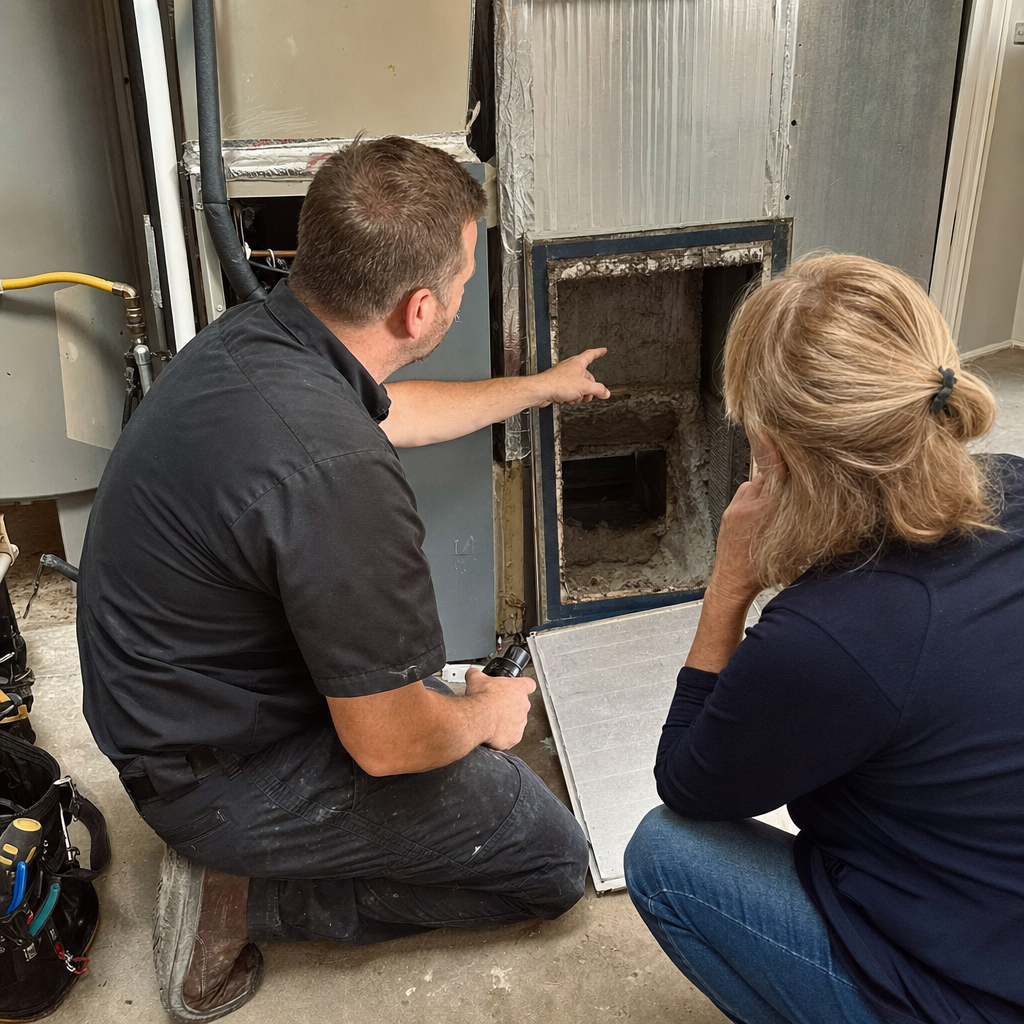
Here’s the difference between “we ran a brush through it” and “your vent is clear.” At Nova Air Duct Cleaning Tennessee, Ronald Sanchez measures airflow in cubic feet per minute (CFM) at the exterior cap before and after cleaning. We use professional-grade equipment — Rotobrush rotary-brush systems and Nikro negative-air machines — to agitate and extract compacted buildup, not just push it around.
The post-cleaning CFM reading tells us whether the restriction is actually gone. Sometimes we’ll run the brush, extract material, and the CFM still reads low. That means there’s a secondary restriction — maybe a sagging duct in a crawl space, maybe a pest nest, maybe lint that compacted so hard it needs additional agitation. We keep working until the number confirms clear airflow.
I’ll tell you what’s in there, what it means, and exactly what it takes to fix it — nothing more. That’s the standard Ronald set when he started this business, and it’s why our home page leads with straight talk, not slogans.
Budget operators with repurposed shop vacs can’t do this. They don’t have the equipment, and they don’t have the eight years of duct-specific experience to know what “clear” actually sounds and measures like. When Ronald shows up at your door in Tennessee, he’s the one doing the work — not a subcontractor learning on your house.
Common Local Scenarios We See Across Tennessee
Every region has its predictable patterns. Here are the situations we encounter regularly:
Long vent runs in ranch homes with crawl space routing
Homes built in the 1960s through 1980s across Tennessee often route dryer vents through 20-plus feet of flexible duct in crawl spaces. The sag points collect lint. The unconditioned space exposes the duct to temperature swings that accelerate condensation. By the time the homeowner notices longer dry times, the sag point is packed solid with moisture-hardened lint. We bring the Nikro negative-air system to these jobs — it’s the only way to extract material that dense without disassembling the run.
New construction with “up to code” vents that don’t actually vent well
Code-compliant doesn’t mean performance-optimal. We’ve cleaned vents in newer subdivisions outside Franklin and Murfreesboro where the builder used the maximum allowable run length with multiple elbows to reach an exterior wall. The vent passes inspection but creates enough static pressure that lint accumulates within two to three years. Homeowners are surprised because the house is new. The design was marginal from day one.
Rental properties with years of neglected maintenance
Landlords and property managers call us when tenants complain about dryers not working. Often we find vents that haven’t been cleaned in five-plus years, with compacted lint reduced to a fraction of original airflow. We document before-and-after CFM readings for property records, and we can schedule recurring maintenance to prevent the next failure. Our 90 verified reviews averaging 4.7 stars include several from property managers who needed professional documentation they could stand behind.
Homes with indoor vent kits or lint traps
Some Tennessee homes — especially older apartments or converted spaces — use indoor venting kits with lint traps instead of exterior termination. These are problematic in humid climates. The trap catches some lint, but moisture and fine particles recirculate into the living space. We recommend exterior venting where possible, and we can advise on routing options during our assessment.
What Happens If You Ignore the Signs
The progression isn’t hypothetical. We’ve opened vents and found the consequences.
First, energy costs rise. A dryer with restricted airflow runs 30–50% longer to achieve the same result. In Tennessee’s climate, where air conditioning already works hard, that extra heat load in your laundry room doesn’t help.
Second, component failure. Thermal fuses, heating elements, and moisture sensors fail prematurely from heat stress. A $150 vent cleaning prevents a $300–$500 dryer repair.
Third, fire risk. The U.S. Fire Administration reports approximately 2,900 home dryer fires annually, with failure to clean as the leading cause. In humid climates, the lint is denser and can hold more heat before igniting — but it also insulates better, creating hotter surface temperatures.
Fourth, mold and indoor air quality issues. When humid exhaust backs into the laundry room, you’re introducing moisture into a space that often has limited ventilation. We’ve found mold growth behind dryers and in adjacent wall cavities that homeowners attributed to plumbing leaks.
How Often Should Tennessee Homeowners Clean Dryer Vents?
For most single-family homes in Tennessee, we recommend annual inspection and cleaning every 12–18 months. Homes with heavy laundry use — families with children, home-based businesses, multiple pets — may need cleaning every 6–12 months.
The 12–18 month guideline assumes no other risk factors. Adjust shorter if you have: a long vent run (more than 15 feet), multiple elbows, flexible foil or plastic ducting instead of rigid metal, an older dryer with less efficient airflow design, or if you’ve already experienced one of the early warning signs listed above.
We also recommend more frequent attention for homes in particularly humid microclimates — near bodies of water, in heavily wooded areas with limited air circulation, or in older homes with less effective envelope sealing.
FAQs
Dryer vent cleaning in Tennessee typically ranges from $120 to $250 for a standard residential single-story home with accessible exterior termination. Longer vent runs, multiple stories, or severely compacted clogs requiring extended agitation may fall at the higher end. Call (844) 621-7071 for an exact quote — estimates are free, and we’ll ask about your vent length and access to give you a firm number before scheduling.
DIY dryer vent cleaning kits cost $20–$40, but in Tennessee’s humid climate they’re often insufficient for moisture-compacted clogs and can’t confirm actual airflow restoration. Professional cleaning with measured CFM verification costs more upfront but prevents the heating element failure, fire risk, and energy waste that restricted vents cause. For most homeowners, professional cleaning every 12–18 months is the more economical choice over a dryer’s lifespan.
We often have same-day or next-day availability for dryer vent cleaning across our Tennessee service area, especially for situations with burning smells or complete airflow blockage. Call (844) 621-7071 — we’ll let you know current scheduling and prioritize true safety concerns.
A properly cleaned dryer vent should show full flapper movement at the exterior cap during operation, noticeably shorter dry times, and — most importantly — measured airflow confirmation. At Nova Air Duct Cleaning Tennessee, Ronald Sanchez provides before-and-after CFM readings using professional equipment. If your previous cleaner couldn’t or wouldn’t show you numbers, you don’t know the job was complete.
When to Call Nova Air Duct Cleaning Tennessee
If you’ve noticed humidity in your laundry room, musty clothes, a sluggish vent cap flapper, or any of the classic performance signs, your vent is telling you something. In Tennessee’s climate, waiting means the clog gets denser, the dryer works harder, and the repair bill grows.
Ronald Sanchez brings eight years of specialized duct and vent experience, professional Rotobrush and Nikro equipment, and a straightforward assessment process to every job. No upsell pressure. No subcontractor roulette. Just measured results and clear explanations.
If you’d rather have it looked at, Nova Air Duct Cleaning Tennessee offers a no-pressure assessment in Tennessee — call (844) 621-7071.
Written by Ronald Sanchez, Owner & Lead Technician at Nova Air Duct Cleaning Tennessee, serving Tennessee, TN.